


Insulation Testing Basics Explained
Insulation testing for installation and maintenance applications
Insulation testing is used to assess the condition and integrity of insulation within electrical conductors and equipment. This article outlines key testing considerations, explains diagnostic methods including Polarisation Index (PI) and Dielectric Absorption Ratio (DAR), and highlights important factors when selecting insulation testing equipment for installation, servicing and maintenance applications.
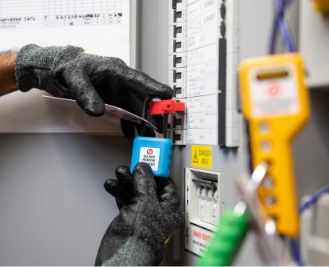
Simply put, insulation testing measures the condition of a conductor’s insulation and the internal insulation of electrical equipment. This is essential for the safe operation of items such as motors, generators, transformers, and of course cables. Over time however, through normal usage, insulation can be exposed to thermal stress, electrical stress, contamination, and moisture, which can significantly reduce its performance and increase both the risk of failure and potential danger to workers. Therefore, proving the integrity of insulation is essential.
Test considerations
Whether installing, servicing or maintaining electrical infrastructure or machinery, insulation testing is critical to ensure safety. When selecting a tester there are many solutions available, from a wide range of manufacturers. It is key to ensure the right choice, both long and short term, is made for the specific application. Fundamentally, what is the range of equipment to be tested and what are the voltage requirements for the actual test? Is the test regime to be simple one-off measurements or longer-term monitoring? Other considerations are more environmental and operational; who will use the tester, what safety rating is needed, what operator skill level is needed and where will these tests need to be done?
If the measurement of insulation degradation over time is required, more diagnostic indices will be needed beyond single-point insulation resistance values. This is generally achieved by two widely used measurement methods: Polarisation Index (PI) and the Dielectric Absorption Ratio (DAR). PI and DAR are powerful diagnostic tools for insulation testing. While DAR offers a fast-screening method, PI provides a more thorough evaluation of long-term dielectric performance.
Polarisation Index
The Polarisation Index (PI) is a diagnostic measurement used mainly to assess the insulation condition of high-voltage equipment such as motors, generators, and transformers. PI is the ratio of the insulation resistance measured at 10 minutes to the insulation resistance, measured at 1 minute after applying a DC voltage test. A healthy insulation system shows decreasing current over time (so resistance increases), giving a high PI. However, if the insulation is wet, dirty, or deteriorated, the resistance doesn’t rise as much after the first minute, leading to a low PI.
Dielectric Absorption Ratio
Dielectric Absorption Ratio (DAR) is another insulation diagnostic test, similar to the Polarisation Index (PI), but measured over a shorter time frame. It is the ratio of insulation resistance (IR) measured at 60 seconds to the IR, measured at 30 seconds after applying a DC test voltage. DAR provides a quick indication of insulation condition and is useful when time does not allow for the full 10 minute PI test. It is more commonly applied to smaller equipment or used in field service applications.
Insulation Testing Solutions
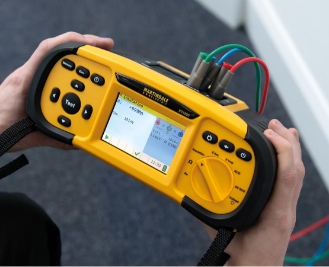
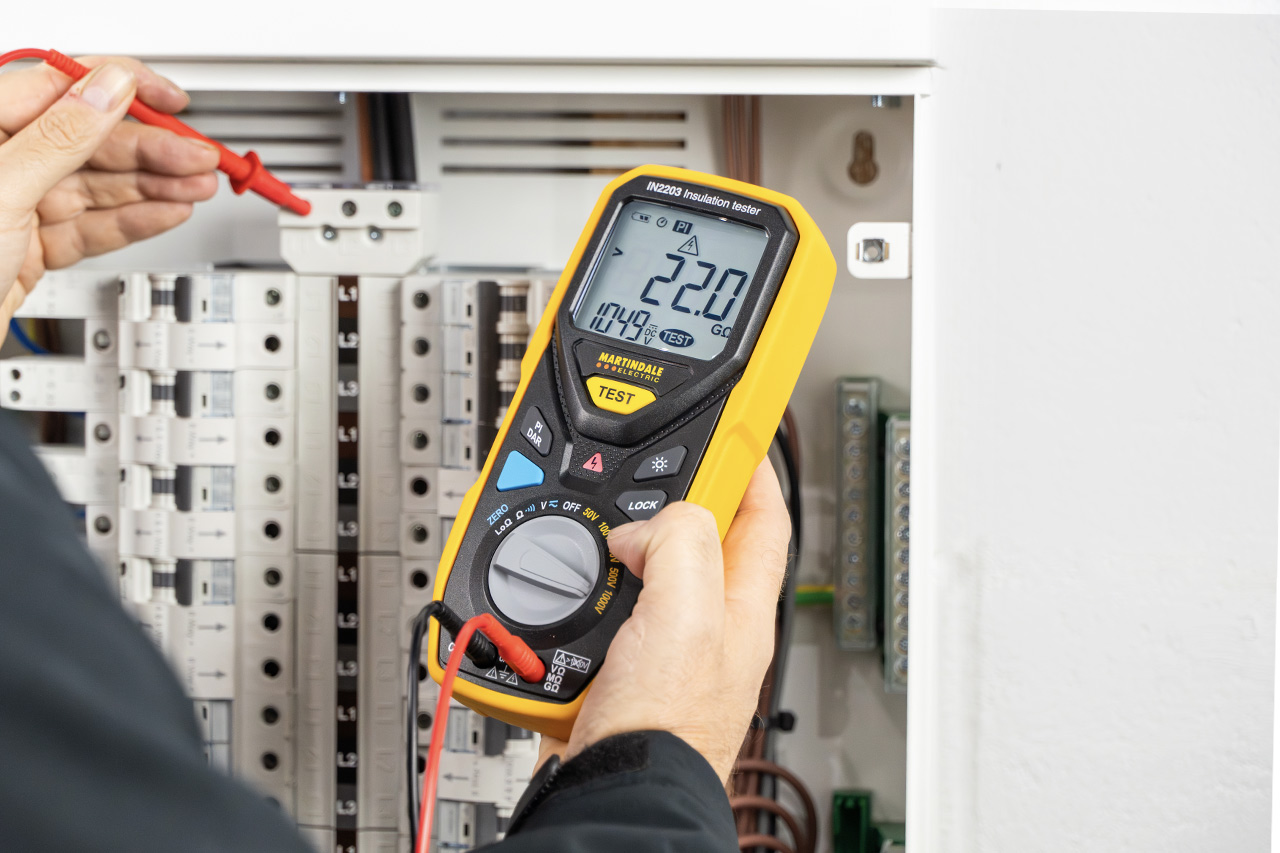
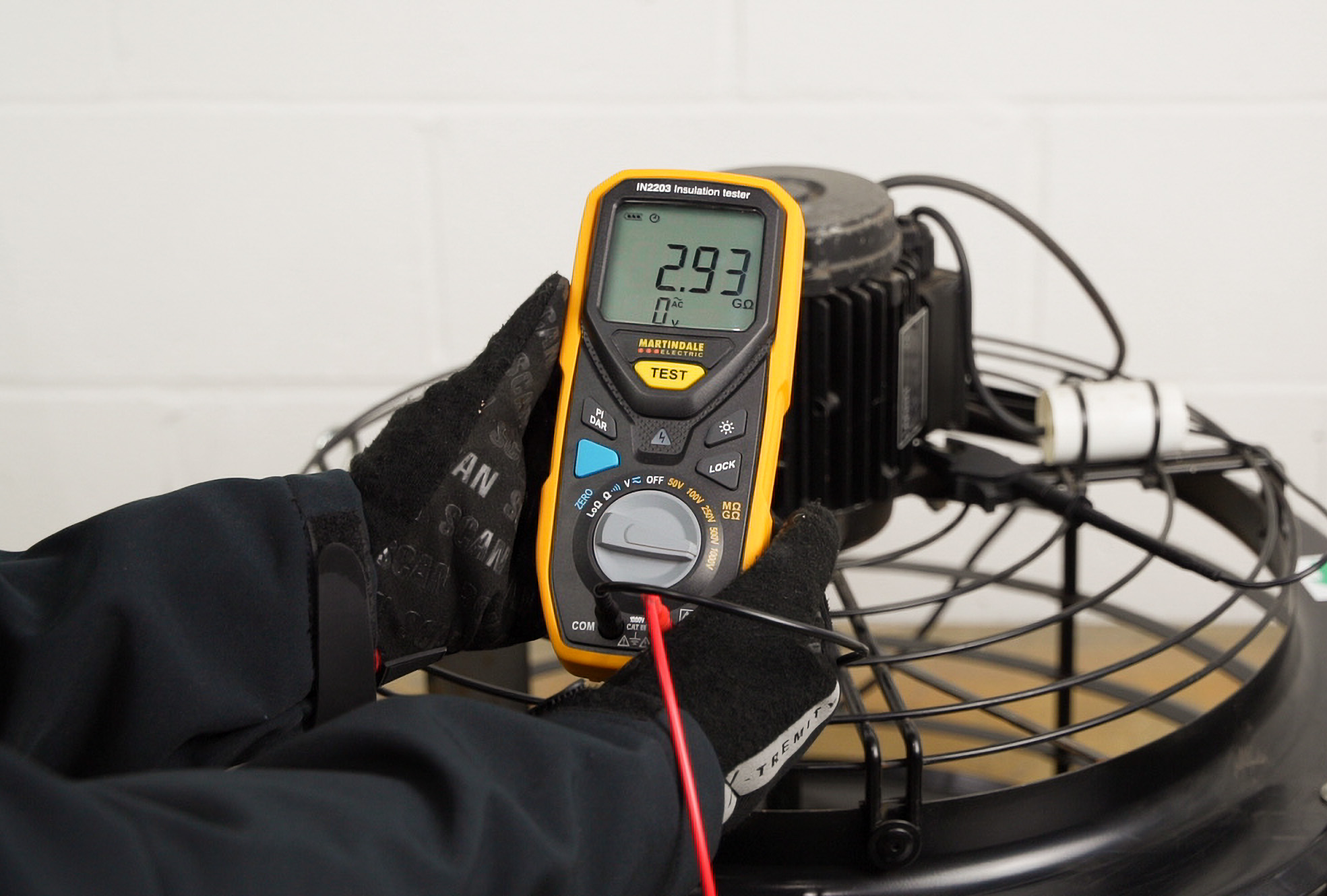
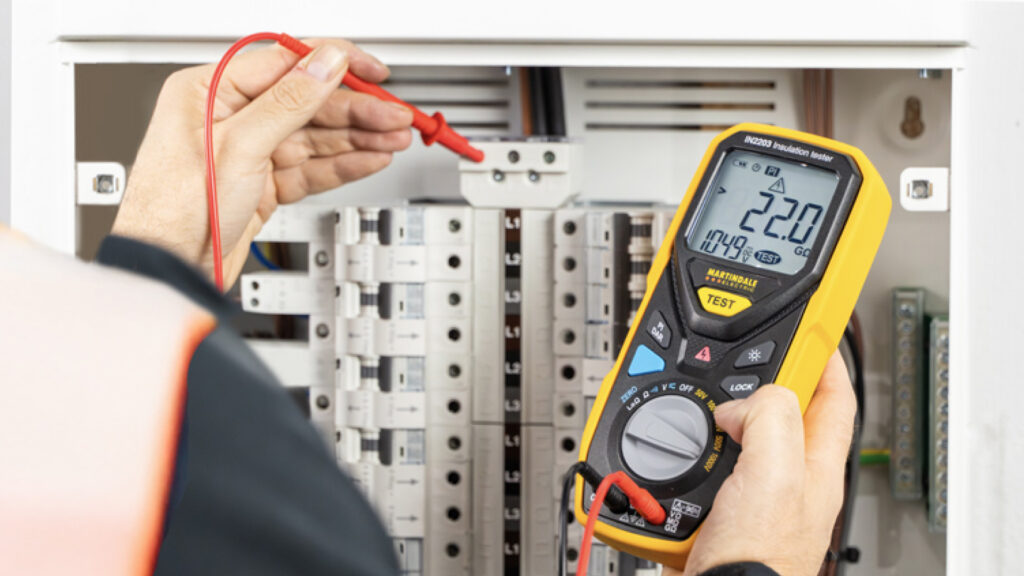
To cover the widest range of functions and environmental considerations, test and measurement specialist Martindale Electric introduced the IN2203 Advanced Insulation Tester, an ideal solution for both installation and service applications. This handheld unit combines a wide range of test functions in a single, compact device, including fully functioned insulation tester. With five selectable test voltages, from 50V up to 1000V, it can measure up to 20G Ohms. It also incorporates a Lo-ohms earth-bond continuity (200 mA) test.
To determine insulation quality and its performance over time, the IN2203 includes measurement capability for both Polarisation Index (PI) and Dielectric Absorption Ratio (DAR).
- The unit is compact and features a rugged outer casing for use in harsh environments.
- For poorly lit applications the extra-large LC display with background lighting gives a high level of visibility.
- For convenience additional multimeter type measurement functions are included as standard: AC and DC Voltage up to 1000V, standard resistance measurements up to 600K Ohms plus continuity test with an audible buzzer.
- The unit has a safety rating of EN 61010 CAT IV / CAT III 1000V. For additional safety, the live circuit detection check inhibits testing on live circuits.
Summary
The Martindale IN2203 Insulation tester is the ideal multipurpose tool to evaluate insulation condition streamlining the process by combining insulation resistance testing with automated PI and DAR calculations. This gives engineers an efficient and reliable way to monitor insulation health in both installation and maintenance applications.